
Perform Your Best When It Matters Most
If you want more info about our services, complete this form and we’ll get back to you within 24 hours.
Your choice of self-paced or guided sessions via Zoom. Perfect for individual athletes, coaches, parents, performers or business professionals.
Learn more »

Customized online mental training programs for athletic teams (separate training for coaches and parents included).
Learn more »

Help people perform their best when it matters most. Become a Certified Mental Trainer® and start a successful career in applied sport psychology.
Learn more »

MTI’s expert speakers deliver powerful keynote presentations as well as half and full day workshops. Ideal for corporations & organizations.
Learn more »
Mental Training Builds Mental Toughness
Mental Training, Inc. (MTI) provides customized mental training and sports psychology services for coaches, athletes, parents and business professionals of all ages and skill levels. We teach mental skills that prevent slumps, blocks and fears so you can develop mental toughness and achieve peak performance.
“MTI understands what golfers need to develop mental toughness.”
– Cameron McCormick (Coach of Jordan Spieth)




Sports Psychology for Athletes and Coaches
Over the past 50 years, sport psychology has become one of the most popular fields of study within the discipline of psychology. The term sports psychologist has been used to describe practitioners who teach sports psychology to performers, specifically how they can enhance their performance. MTI has trademarked the term Mental Trainer® to distinguish their performance enhancement services for other “rehabilitative counseling” services. Many sports psychology books have been written, including Roadmap to the Zone written by MTI Founder Dr. Robert Neff that offers a sports psychology consultation in a book.
Developing Mental Toughness
In the early 1980’s, Dr. Jim Loehr published a ground-breaking book called Mental Toughness Training for Sports. It was the first book that discussed mental toughness techniques in ways the average reader could understand. For years, Dr. Loehr wrote mental toughness articles in Tennis Magazine, which motivated others to apply his techniques to golf, gymnastics, figure skating, football, basketball, baseball, hockey, and now, to every activity that involves performance. Since then Dr. Robert Weinberg has become a prolific publisher of practical mental training information. Dr. Weinberg has joined Dr. Neff as an MTI Mental Trainer® and shareholder.
Mental Training for Athletes and Other Performers
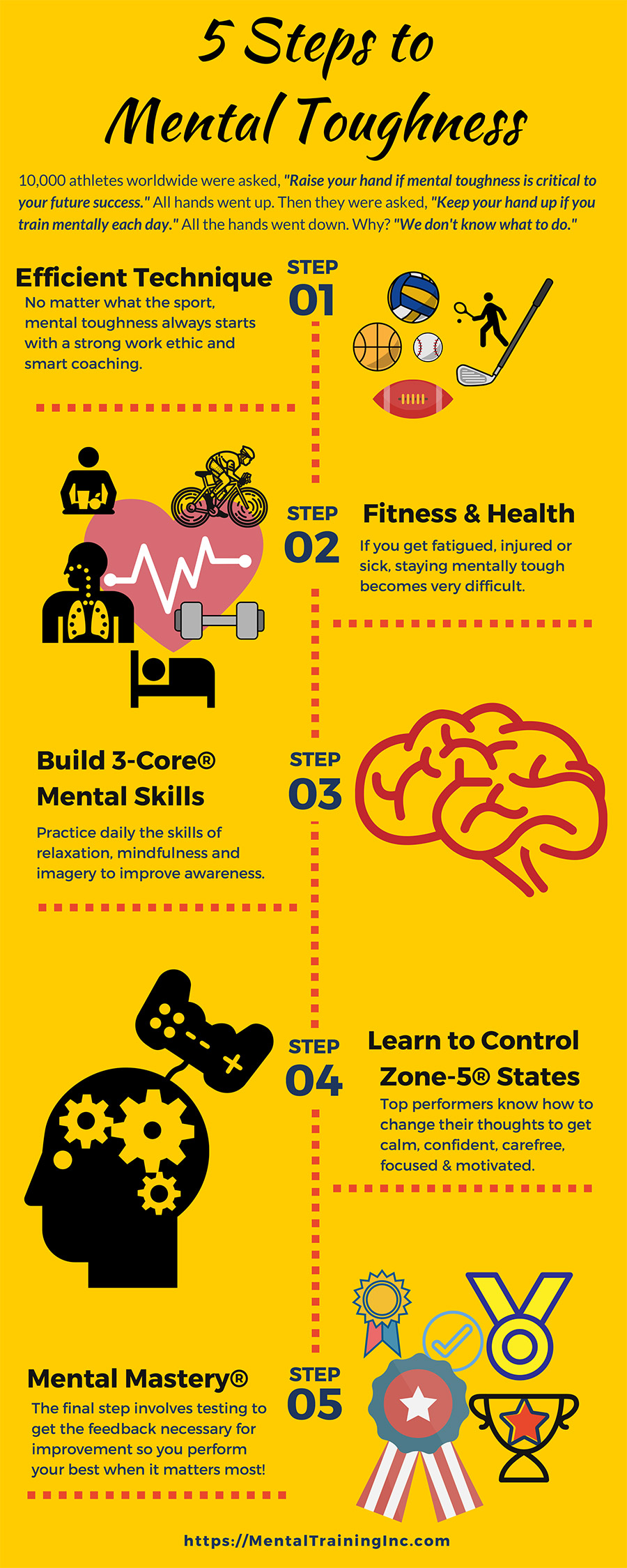
Sports psychology is a broad term used to describe the division of psychology related to the study of sport and exercise. Mental training is a more specific term used to describe the mental techniques necessary for consistent high performance. Mental training for athletes often includes goal setting, visualization, mental imagery, self-talk retraining, mind control training, emotion control and in general, ways to establish true ideal thoughts, images and emotions to enhance sports performance.
Performance Anxiety
Performance anxiety is perhaps the most common problem experienced by athletes. The athlete feels anxiety as the competition is approaching, or during specific times during the competition, that produces mistakes and errors in judgment. Mental skills have been developed specifically for this condition. Calm, confident and carefree are words used by athletes to describe how it feels during periods of high performance. The ‘zone’ is the opposite of performance anxiety and can be controlled by any athlete who has the discipline to learn and practice mental skills.
Mental Health Disorders
If you have a mental health disorder that you think might require a mental health therapist, we can help guide you in the right direction. In order to improve the performance of athletes who do not have mental health disorders, we need to be able to determine whether a disorder exists in the first place. We can then refer a person with psychological disorders (like anorexia, phobias, etc) to a specialist within the Texas mental health system. If the problem seems minor and more related to faulty thinking and bad habits, there are very effective Mental Trainer® solutions that we can teach.
Mental Strength Training
Mental strength training involves learning and practicing mental skills that strengthen the ability to control thoughts, emotions and performance. As an example, if there are certain thoughts that tend to cause nervousness, an experienced athlete will know what those thoughts are, be able to recognize them during competition, be able to get those thoughts out of the mind, and then insert the proper thoughts. The result is an emotion more ideally suited to optimal performance. Mental Strength is developed by a special type of “adversity training” implemented in practice that prepares the person for upcoming performances.